
 Close
Close


Stem Cell Treatment
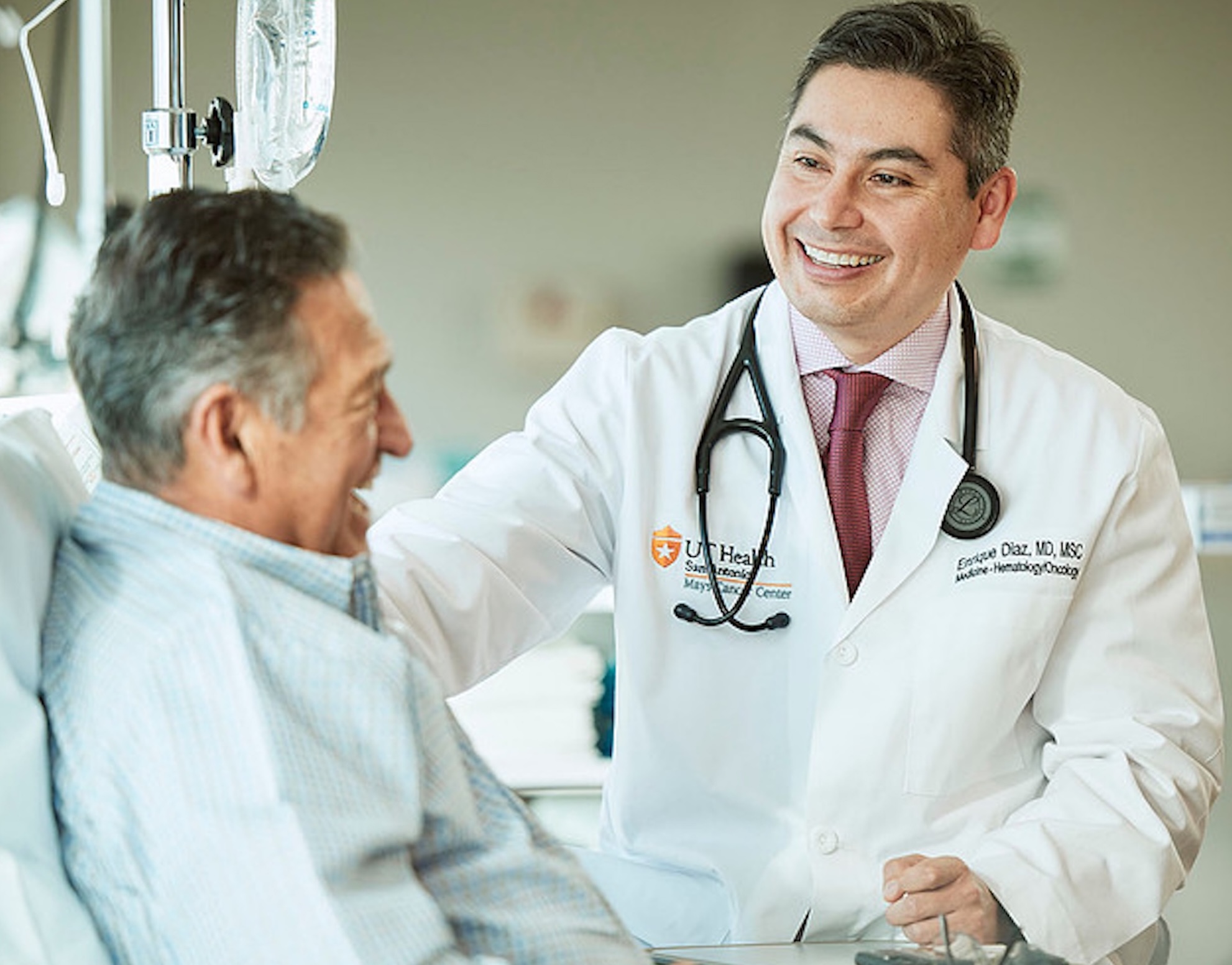
We are the first academic National Cancer Institute (NCI)-designated Cancer Center in South Texas to offer this advanced treatment.
The Stem Cell Transplant and Cellular Therapy Program at Mays Cancer Center provides stem cell therapy to Hodgkin lymphoma and non-Hodgkin lymphoma, multiple myeloma and testicular cancer patients.
What is stem cell therapy?
Stem cell therapy is also called stem cell treatment or transplant. It uses healthy stem cells to replace blood cells that are affected by chemotherapy treatment. While chemotherapy destroys cancer cells, it also destroys healthy cells. The stem cells used for transplant can come from the patient themselves or from a viable donor.
Types of stem cell therapy
There are two main types of stem cell treatment, including:
- Allogeneic stem cell transplant (SCT): An SCT uses stem cells from a donor, who may be a relative or someone who is not related. Before the procedure, the patient receives a conditioning treatment to prevent their immune system from rejecting the donor cells. The conditioning treatment may include chemotherapy, radiation or both. The new cells flow through the patient’s bloodstream to the bone marrow. SCT is typically used for types of leukemia.
- Autologous stem cell transplant (ASCT): In an ASCT procedure, your own stem cells are collected (harvested) before high-dose chemotherapy treatment and saved (banked) for use later. After you have chemotherapy — and radiation, if you receive both treatments — the banked stem cells are returned to your body. Autologous transplant is typically used for Hodgkin lymphoma, non-Hodgkin lymphoma and myeloma. It can also be used for testicular cancer.
We currently perform only autologous stem cell transplant at Mays Cancer Center.
Why choose us for stem cell treatment?
You have many reasons to trust in Mays Cancer Center for your stem cell treatment. We offer:
- Academic-level expertise: Academic health centers provide a combination of benefits. These benefits include subspecialty-trained doctors, access to the latest developments in clinical research and advanced medical care and treatment facilities.
- Comprehensive care: Our stem cell therapy team collaborates across specialties including hematology, oncology, radiology and support services. Our team focuses on providing you the full spectrum of coordinated, comprehensive care.
- NCI-designated center: As a National Cancer Institute-designated Cancer Center, Mays Cancer Center has achieved rigorous standards of scientific excellence. We use state-of-the-art research to inform prevention, diagnosis and treatment methods.
- Patient-centered treatment: Every aspect of care at Mays Cancer Center considers your personal needs and preferences. Our care team works collaboratively with you to create a care plan that is realistic for you and your daily life.
Stem cell treatment: What to expect
Autologous stem cell treatment involves several steps leading up to transplant:
Step 1: Referral and evaluation for stem cell therapy
You will need a referral from your hematologist to be considered for transplant.
You will meet with a transplant doctor as an outpatient at Mays Cancer Center. Together, you will review your health history and discuss the procedure, its benefits and any potential risks. A coordinator will help verify your insurance coverage for the procedure.
Step 2: Pre-transplant work-up for stem cell therapy
Your pre-transplant work-up will include several tests to help determine whether you qualify for stem cell therapy. They include:
- Blood and urine tests
- Bone marrow assessment
- Dental exam (to find and treat any possible areas of infection, because your immune system will be weakened during stem cell treatment)
- Heart and lung function tests
- Imaging such as a CT or PET scan
- Organ function test
- Psychosocial evaluation
Step 3: Preparing for stem cell treatment
After the test results come back, you will meet with your doctor to go over any questions, confirm your readiness and consent for the procedure.
A few days before your stem cell collection, you will start taking specific medications as a daily injection. The injections help your body produce more stem cells and move them from the bone marrow to your bloodstream. These medications can cause minor side effects such as aches and pains or flu symptoms.
Step 4: Stem cell collection
You will then return to Mays Cancer Center as an outpatient for stem cell collection. We take blood from a vein in your arm, like when you donate blood. It will then be processed through a machine that extracts the stem cells, which are then frozen and stored in the lab. This process is repeated daily for a period of one to five days.
Step 5: Conditioning regimen and treatment for stem cell therapy
You will then be admitted to UT Health San Antonio Multispecialty and Research Hospital. There you will be given high-dose chemotherapy treatment, along with radiation if it is part of your treatment plan. This may last over the course of about a week. The treatment destroys cancerous cells in preparation for transplant.
Step 6: Stem cell transplant and monitoring
Your transplant (engraftment) will be scheduled a day or two after your last chemotherapy and radiation dose. The frozen stem cells are thawed and then given to you through an infusion.
The stem cells flow from your bloodstream into the bone marrow. They then begin producing new blood cells to replace those that the chemotherapy destroyed. Your stem cells will regrow, and blood counts will rise over a course of days to a couple weeks after your transplant.
You will remain in the hospital for a few weeks to receive ongoing medical care. In some cases, you may need additional blood transfusions of platelets or red blood cells. During this time, you will be especially prone to infections. You may be given antibiotics to prevent or treat them.
Discharge and home recovery
After you are discharged and return home, you will have frequent outpatient follow-up appointments with your doctor. These last for the next four to six weeks. Your doctor will monitor you for complications and ensure your immune system is recovering.
Recovery from autologous stem cell transplant can be slow. It may take a few or several months for you to begin feeling like your usual self.
Frequently asked questions about stem cell therapy
Who is eligible for stem cell therapy?
Your doctor will consider several factors to determine your eligibility for stem cell therapy. They will review your:
- Age
- Availability of your own stem cells or a donor’s
- General health and fitness
- Physical exam results
- Prior medical treatments
- Stage and type of cancer
Your doctor will also consider the likelihood that your body will respond well to the treatment.
People with significant health issues such as heart, kidney, liver or lung conditions may not be candidates for stem cell therapy.
What are the risks and side effects of stem cell therapy?
What are the risks and side effects of stem cell therapy?
Autologous stem cell transplant is less risky than an allogeneic transplant.
There is a small risk that an autologous transplant might not take (graft failure). This means the new cells fail to enter the bone marrow and make blood cells as intended.
There is also a chance that some cancer cells may remain in your stem cells after the collection process. They may not show up for months afterward.
Side effects of autologous stem cell therapy depend on your overall health, the type of chemotherapy and the type of transplant. Side effects typically come from chemotherapy and can include:
- Diarrhea
- Fatigue
- Fertility issues from damage to testes or ovaries, either temporary or long-term
- Hair loss
- Low blood cell counts leading to anemia, bleeding or infection
- Mouth sores
- Nausea
- Second cancers, though rare
- Skin issues such as itchiness
Your doctor will go over possible side effects based on your personal circumstances.
What are the benefits of stem cell therapy?
Autologous stem cell transplant has several benefits. There is no risk of your body rejecting the stem cells since your own cells are used instead of a donor’s. There is also no risk of graft-versus-host disease, where your immune system attacks the donor stem cells.
Most importantly, stem cell transplant can lead to cancer remission for some people, while other treatments or chemotherapy alone cannot.
Advanced Care Clinic
The Advanced Care Clinic (ACC) at the UT Health San Antonio Multispecialty and Research Hospital provides 24-hour specialty care. It’s designed for patients that have complications or side effects after a procedure, surgery or treatment. It is also for cancer patients. The ACC is staffed by doctors who provide expert diagnosis and care. It requires a referral from your oncologist or hematologist.
The ACC does not offer general emergency or urgent care services.
Learn more about the Advanced Care Clinic or call 210-450-1000 for a referral.
Survivorship services
Our Cancer Survivorship Program is available to support you well beyond the treatment phase. We focus on both the physical and emotional sides of cancer, promoting your ongoing wellness and quality of life.
Learn more about the Cancer Survivorship Program.
Care locations
Zeller Building
- Hematology-Oncology | 3rd Floor
- Stem Cell Transplant and Cellular Therapy Program | 3rd Floor
- Hematology Infusion Center | 3rd Floor
UT Health San Antonio Multispecialty and Research Hospital
- Advanced Care Clinic | Entrance at the back of the hospital, off James P. Hollers Drive

Get cancer care
Visit one of our hematologic cancer experts to confirm a diagnosis or review your treatment options.